
Children are sponges. Give them a word and they will memorize it. Make a promise and
they will hold you to it. Fall down the stairs and they will remember it (never happened to me at all). In most children’s early years, an adult might see a form of rapid learning, recall and repetition. Children are full of potential. But then as they grow older they lose interest, focus, concentration. They become more difficult, and sometime put more work into avoidance than what would of been required to get an original job(sometimes literally) done. What happened here? A couple years of intense concentration in study/sports can have huge payoffs in the long run, but yet success stories are few and far between. Where does the potential go? Let us take a look at a children’s mind.

The world that is often explained to a child is relatively simple on the surface. Do the right work and get a payoff. All the child has to do is do what is asked and they get rewarded. Say ‘Dada’ or ‘Mama’? Reward. Start walking? Reward. Eat your veggies? Reward. The human mind is very quick at adapting to this system, and uninterrupted this repetitive work-reward exchange can lead to great success in the soccer field of life. If another child fails to put in the work they fall behind the main achievers. They will only be able to catch up when the error-rate is matched. This system is perfect for building an army of consistency.
But the parent(s) often don’t give children the full story. The real full story is that the system is not perfect at all. The system can be affected by random events, technique, and a principle-agent problem between the child and the parent. And these three things shift a child’s focus away from hard work to something else completely.
Random Events. The terrain of life can be random at times and mess up the work/reward system. This is often temporary but to a child with not much life experience this may seem like a permanent change. For example Child A studies 1 hour for tomorrows test while Child B does not. Both children go to bed and wake up to a snow day. Child A is devastated. Child A followed the risk/reward of life and was provided nothing in return. The system broke down and so does the child. Without an adult to explain the hiccup, the children may make a permanent mental choice on effort over a temporary situation.
Technique. What is also underexplained to children is the importance of looking for the best way to do a task. Children that hyper focus on effort may become depressed when the work/reward system favours knowledge over effort. For example Child A studies 2 hours for tomorrows test, while Child B studies for 1 hour with a tutor and 1 hour playing video games. Both children get the same mark the next day. Sometimes this issue can have barriers (i.e. tutor cost) that children can not adapt to but the flaw in the work reward system remains.

Last but not least and worst of all; Principle and Agent. Both random event and technique can be solved with a parent/adult and are well known but this last one is not. The parent is the principal, and the child the agent. The parent knows what is needed to raise a child, but do they pay all the costs? Parenting is very hard and sometimes parents might resort to tricking the child into a better result for the parent. For example: a parent tells a child to go to bed otherwise the boogeyman will get him/her. Ofcourse the boogeyman doesn’t exist (yet) but the parent wins a years worth of quality free time. Eventually the child catches on eroding trust for the parent. This might occur even on a smaller scale as well. Parents telling lies to get a child to behave. Parents customizing agreed rules to get their way. Parents playing tricks on the child for their families/friends laughter and enjoyment. Now lets scale this back. Stealing a child’s candy does not directly spawn a childhood bully. These tricks are often well measured. But the child does not know that. So the child does what the child does best, soak up the new game like a sponge.
The ‘something else completely’ that children turn away from hard work to is the efficiency game. What is the most I can get out of the least amount of time/effort. This game becomes an obsession to identify and exploit weaknesses. For example: Child B doesn’t study for a test while Child A studies 2 hours, but at school Child B tells the teacher his parents got really sick. The teacher gives Child B extra time to study. Child A sees the exploit and digs within looking for another exploit to win back the time lost due to hard work inefficiency. Slowly under the normal soccer field of life is an advance tunneling system of an exploitation highway.
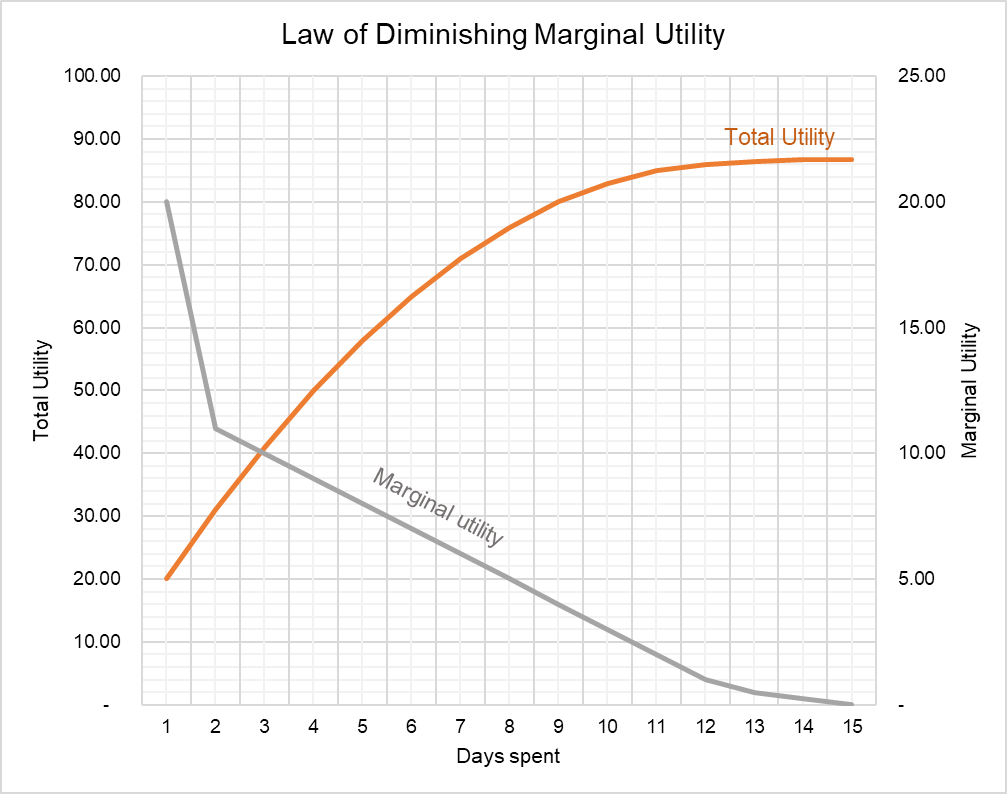
Some children may believe they are bad at math, but their trail and error actions build a different story. To avoid a surprise economics lecture, let’s simplify the below graph. Imagine the left Y axis as the percentage grade of a child, and on the X axis the amount of days spent studying. The orange curve is what we can call the happiness level from studying. A non-exploit child will simply study the full 15 days to get as high of a mark as possible. An pro-exploit child may study until day 8 or 9, and switch to playing video games for the last 6 days. Child A gets a 86% and Child B gets a 75-80% and 6 days of gaming bliss. As children learn more ways to find happiness and enjoyment, their grade may dip further as they give up more time doing the less exciting studying for these new ventures.
Over time children may get really good at this and start to use their knowledge to exploit each other. After years of exploit training, the young adolescent may start to test and exploit their parents.
Can parents avoid this? Outside of overwhelming a child with lectures at birth I think that parents have to come to terms of monitoring their child’s experience in life and to pair it honestly with new details of explanation. Parenting seems to also be a double sided sharpening stone that requires a parent to build character as children are raised. Do parents have their own happiness curve? Yes. But they as adults can not live solely from it anymore. That is because their is one more curve we didn’t talk about. The responsibility curve. A parent sending a child to their room early to be able to binge watch shows is a happiness curve over responsibility problem.
I want to emphasize that I do not in anyway want to tell anyone how to parent. There are sometimes barriers to parenting that can make raising children more difficult. The only point I want to raise is your child is a sponge of what you provide them. Parents telling lies to get a child to behave. Parents customizing agreed rules to get their way. Parents playing tricks on the child for their families/friends laughter and enjoyment. Don’t be surprised if they copy your actions and later on switch their curve priority on you. Will they be successful? Most likely not. They are years younger and less experienced. But the aim is not to win. The aim is to bring things back to the surface of the soccer field where you both can ball up the strength to work together to reach the goal. Passing on your wisdom a child trying to get a kick out of life and having a ball.

 Decoding The Human Mind